
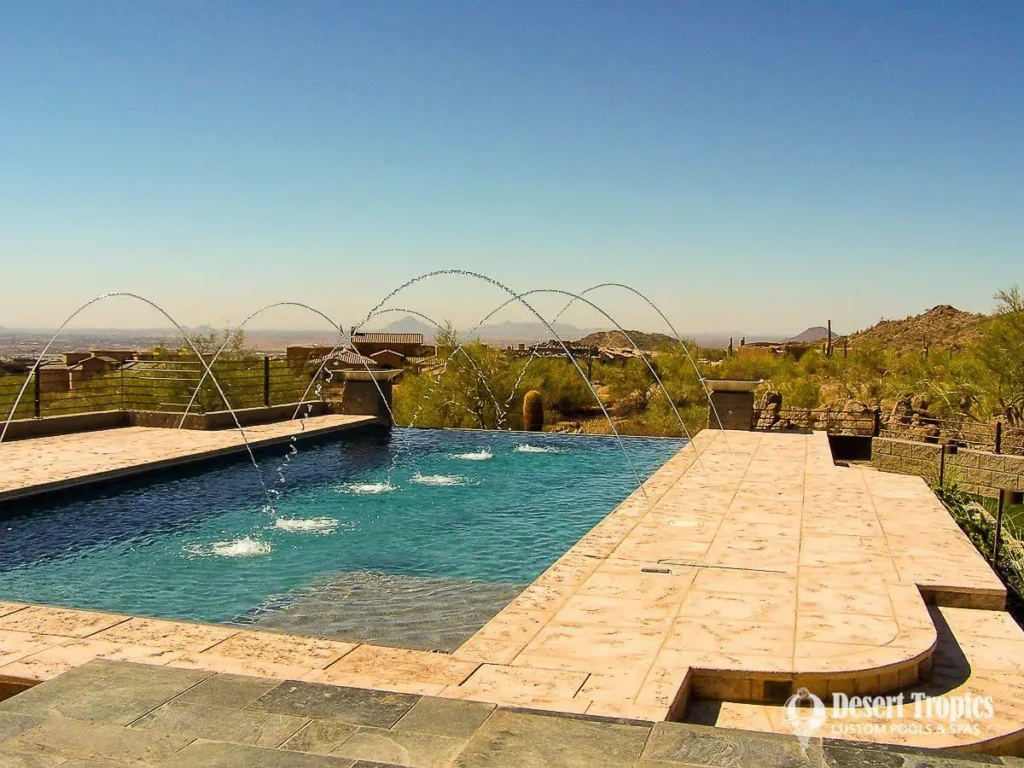
An infinity edge pool only pays off when there’s something worth looking at past the edge and room below it for a catch basin. Plenty of backyards have one and not the other, which is why the edge gets designed around the view and the grade, not bolted onto a standard pool plan.
One of our recent Arizona builds paired an infinity edge with a travertine deck and laminar jets. Here’s what that project teaches about how the edge works, what drives the cost, which materials suit desert heat and how much upkeep to expect.
Key Takeaways
- An infinity edge pool lets water spill over one lowered wall into a catch basin, where a pump returns it, so the surface appears to run into the view.
- It makes the most sense on lots that drop away toward a view, such as hillside properties in North Scottsdale.
- The catch basin, a dedicated pump and structural engineering are what make it a high-budget feature.
- Travertine handles Arizona heat and sun well and frames the water with a calm, natural tone.
- Laminar jets and the spill edge both add movement, and both raise evaporation whenever they run.
How Does an Infinity Pool Work?
An infinity edge pool works by setting one wall slightly below the water line, so water spills over it into a catch basin below. A separate pump sends that water back into the pool, keeping a constant sheet flowing over the edge and making the surface look like it continues into the view.
You’ll also hear it called a negative edge pool or a vanishing edge pool, and the names mean the same thing. What changes from yard to yard is the catch basin. It has to hold the water spilling over plus the water pushed out when people climb in, so its size depends on the edge length and the pool size. That’s engineering work, settled before anyone digs.
| Component | Standard pool | Infinity edge pool |
|---|---|---|
| Walls | All walls finish at the same height | One wall sits just below the water line |
| Water return | Skimmers and returns | Skimmers and returns, plus a catch basin |
| Pumps | Filtration pump | Filtration pump plus a dedicated edge pump |
| Best lot | Almost any yard | A grade that drops toward a view |
| Engineering | Standard pool design | Structural design for the lowered wall and basin |
Is an Infinity Edge Pool Right for Your Backyard?
An infinity edge pool is right for your backyard when the yard slopes away and there’s a view worth framing, such as mountains or open desert. On a flat lot facing a block wall, the edge spills toward nothing, and you pay for a basin and pump without the effect that justifies them.
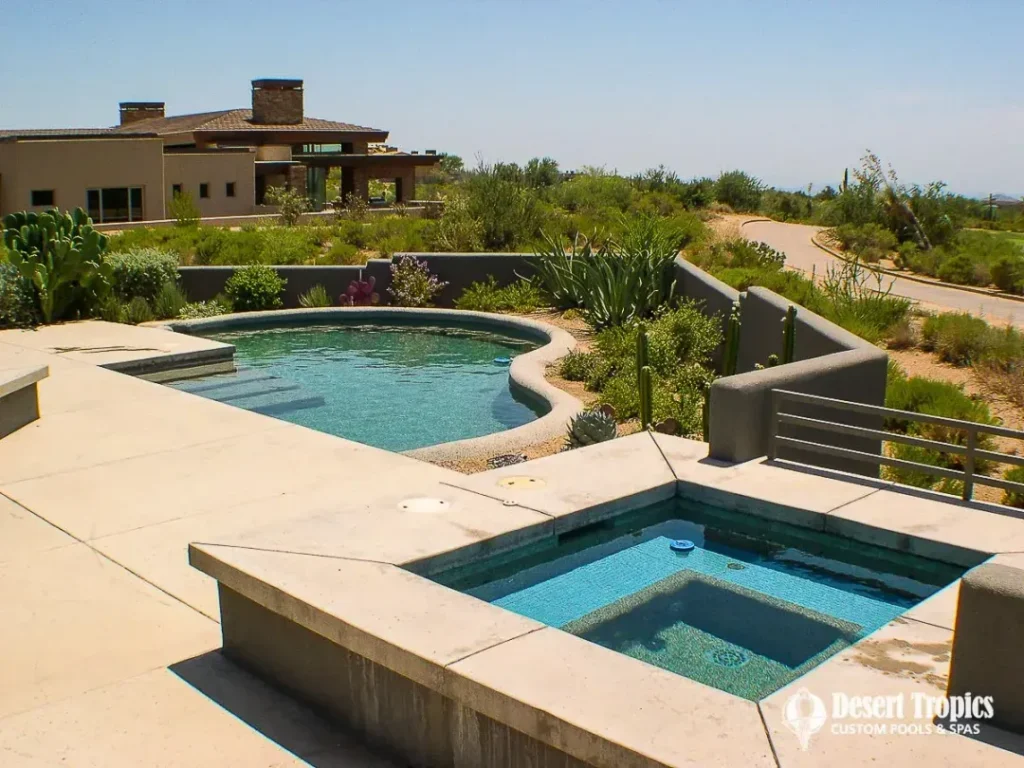
Hillside properties in North Scottsdale and Paradise Valley are a natural fit, and those sites need specific engineering for structural support, drainage and access. Our page for Scottsdale luxury pool builders covers how we plan for them. A backyard infinity pool can still work on a gentler grade if the basin sits just below the deck and the edge faces open space.
What Drives Infinity Edge Pool Cost?
Infinity edge pool cost comes from everything a standard pool doesn’t need: the catch basin, a dedicated pump and plumbing, a lowered wall finished on both faces, and structural engineering for a sloped site. The longer the edge and the steeper the drop, the more each of those adds to the project.
For context, custom pools in the Phoenix area typically start around $60,000 and climb past $100,000 with premium features, and an infinity edge sits firmly in that premium tier. Engineering is more complex for features like this, so our swimming pool construction process puts the edge and basin into the engineered plans, with permits and inspections handled by our team. Before you sign, ask any builder:
- How big the catch basin is and where its pump will sit
- What finish goes on the spill face, since it stays visible
- How the edge will be leveled, because a small error shows as uneven flow
- Where the basin water level sits when the pool is full of swimmers
- How the edge looks with the pump turned off
Why Use Travertine for an Infinity Pool Deck?
A travertine pool deck suits an infinity edge because it handles Arizona heat and sun exposure well, and its soft natural tones frame the water without competing with the view. It’s one of the deck materials we recommend for Valley yards, alongside pavers and other natural stone.
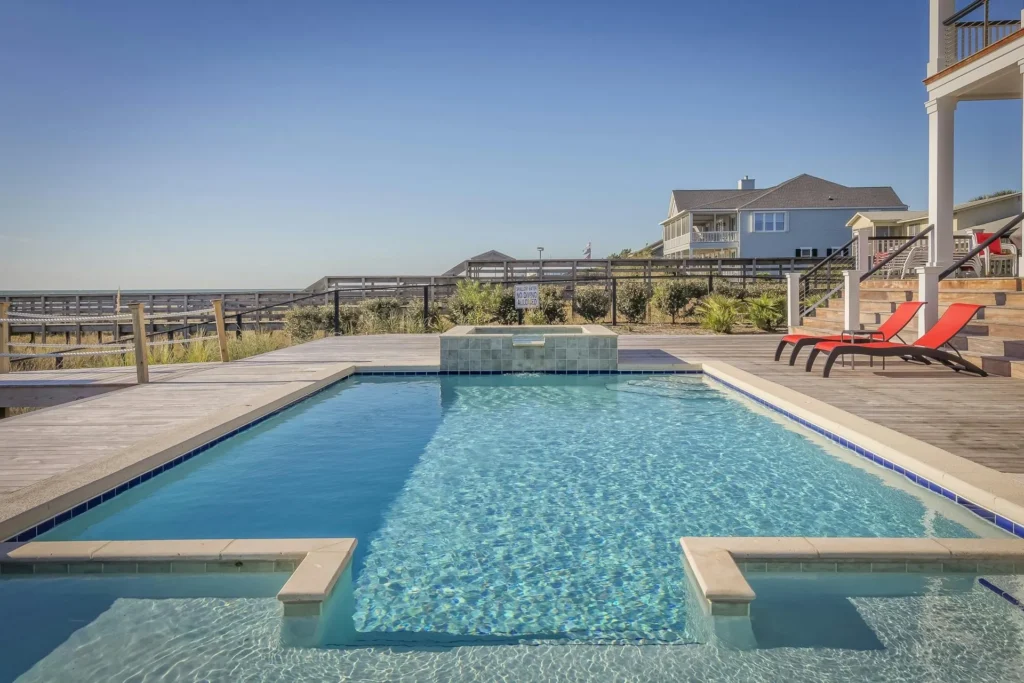
Travertine is porous, so seal it to resist stains from pool chemicals and hard water, and choose a tumbled or textured finish for grip. On an infinity edge, the deck usually wraps three sides and leaves the spill side open, so plan where people will stand to take in the view. Shade, seating and walkways come together in our outdoor living design work.
What Do Laminar Jets Add to an Infinity Pool Design?
Laminar jets send smooth, glass-like arcs of water from the deck into the pool, and many models carry LED light through the stream at night. In an infinity pool design, they add movement and sound on the house side, balancing the quiet sheet of water at the far edge.
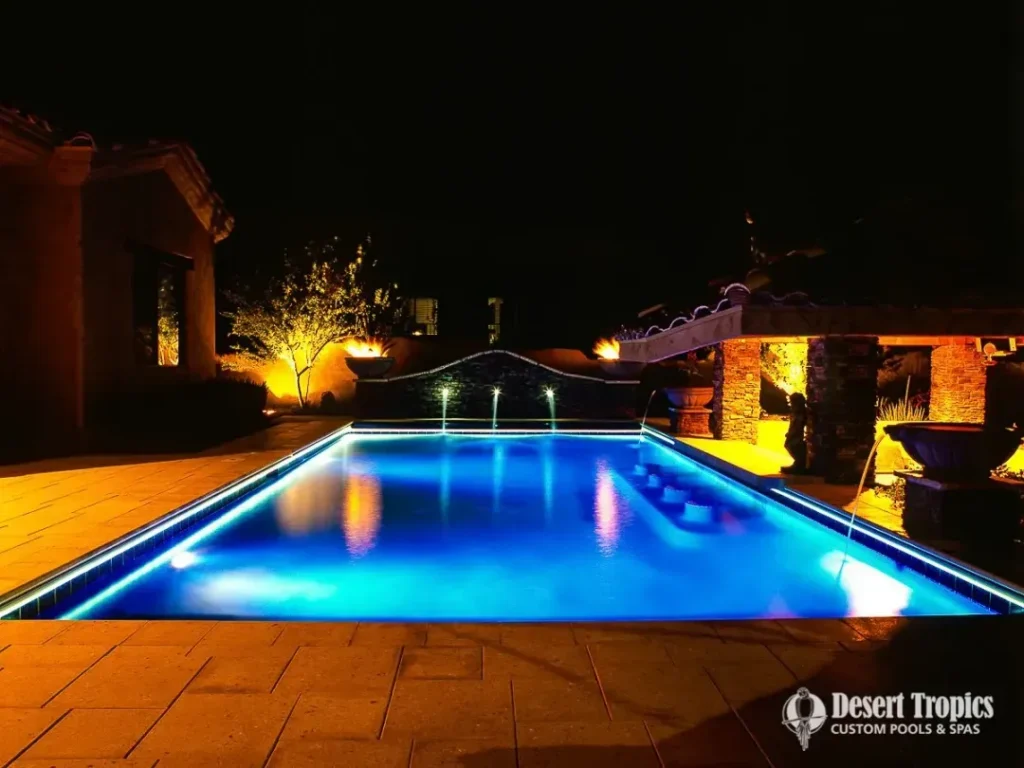
Pentair’s MagicStream laminar guide lists stream heights of about 5 to 6.8 feet depending on water flow, so aim the arcs into open water, away from loungers and the spill edge. Every water feature also raises evaporation. The EPA’s WaterSense pool guide recommends running features only when the pool is in use or on a timer, and the same logic applies to the edge pump.
Infinity Edge Pool FAQs
Are infinity pools worth it?
An infinity pool is worth it when your lot has a real view and a slope that suits a catch basin. In that setting, the edge becomes the defining feature of the yard. On a flat lot without a view, the same money usually buys more enjoyment as a spa, water features or a larger deck.
What happens if you fall off the edge of an infinity pool?
Most residential infinity edges spill into a catch basin a short distance below the pool, so anyone who goes over lands in or beside the basin. On steep lots, the wall below the basin can be tall, which is why the design has to account for drop height, access and Arizona’s pool barrier rules.
How much does an infinity pool cost?
There’s no single price, because edge length, basin size, the drop on your lot and the engineering set most of the number. Custom pools in the Phoenix area typically start around $60,000 and pass $100,000 with premium features, and an infinity edge adds to that baseline. Your project estimate breaks it out.
How long does it take to build an infinity edge pool?
Our custom pools typically take 4 to 5 months from contract to swim day, and an infinity edge adds engineering and detail work, especially on hillside lots. Our guide to how long it takes to build a pool walks through each stage and what can stretch it.
Can you add an infinity edge to an existing pool?
Sometimes, if the grade beside the pool drops enough for a catch basin. It means cutting down one wall, building the basin, adding a dedicated pump and refinishing the pool, so it’s closer to a major remodel than an upgrade. A site visit shows quickly whether your yard can support it.
Planning Your Infinity Edge Pool
The real question is whether your lot has the view and the grade an infinity edge pool needs. If it does, settle the basin, the engineering and the deck layout early, and the edge becomes the part of the yard everyone looks at first.
Since 2001, we’ve designed custom pools across North and West Phoenix with the owner involved in every project, and our design consultations are free. Call (602) 787-1603 or plan your infinity edge with our team and we’ll walk your lot and show you the edge in 3D.