
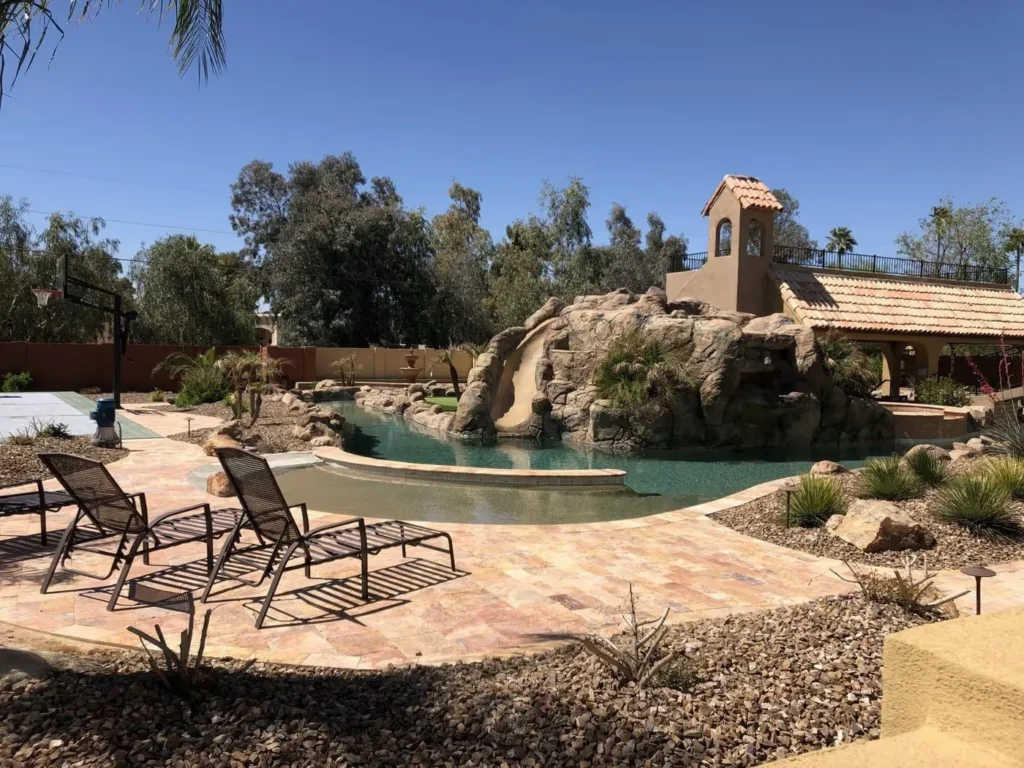
Most families who ask us about a backyard lazy river pool expect it to work like a bigger pool. It doesn’t. A lazy river is a moving channel with its own pump, its own depth limits and its own claim on your yard, and those details decide whether it gets used every weekend or sits there as an expensive moat.
One of our recent Arizona builds paired a lazy river with a beach entry and a rock slide. Those three features compete for space and water depth, and that layout teaches a lot about design, cost, safety and upkeep.
Key Takeaways
- A backyard lazy river pool is a looping channel with a pump-driven current, which adds plumbing, shell and decking.
- A beach entry, a river channel and a slide each need a different water depth, so a good layout gives each one its own zone.
- Slides need deep water where riders land, which is why the slide belongs in the main pool and never in the shallow river channel.
- Arizona law requires a 5-foot barrier with a self-closing, self-latching gate around pools at most homes with children under six.
- Expect a longer build and more evaporation than a standard custom pool.
What Is a Backyard Lazy River Pool?
A backyard lazy river pool is a residential pool with a channel that loops back on itself, where jets push the water in one direction so you can float without swimming. The current usually comes from its own pump and set of jets, on top of the equipment that already filters the water.
It’s still a rare request in the Valley. A lazy river sits at the far end of the pool features we build, next to negative edges and large water features, because it takes more yard and budget than most backyards allow. It earns its space when the goal is a pool everyone uses at once, from the toddler on the beach entry to the grandparents floating the loop. For laps or a quiet soak, a spa or simpler layout costs far less.
How Do a Lazy River, Beach Entry and Rock Slide Fit in One Pool?
They fit when each feature gets its own depth zone. A beach entry pool starts at zero depth and slopes in gradually, a lazy river channel holds an even depth for floating, and a pool rock slide needs deep water where riders land. Put any two of them in the same spot and one stops working the way it should.
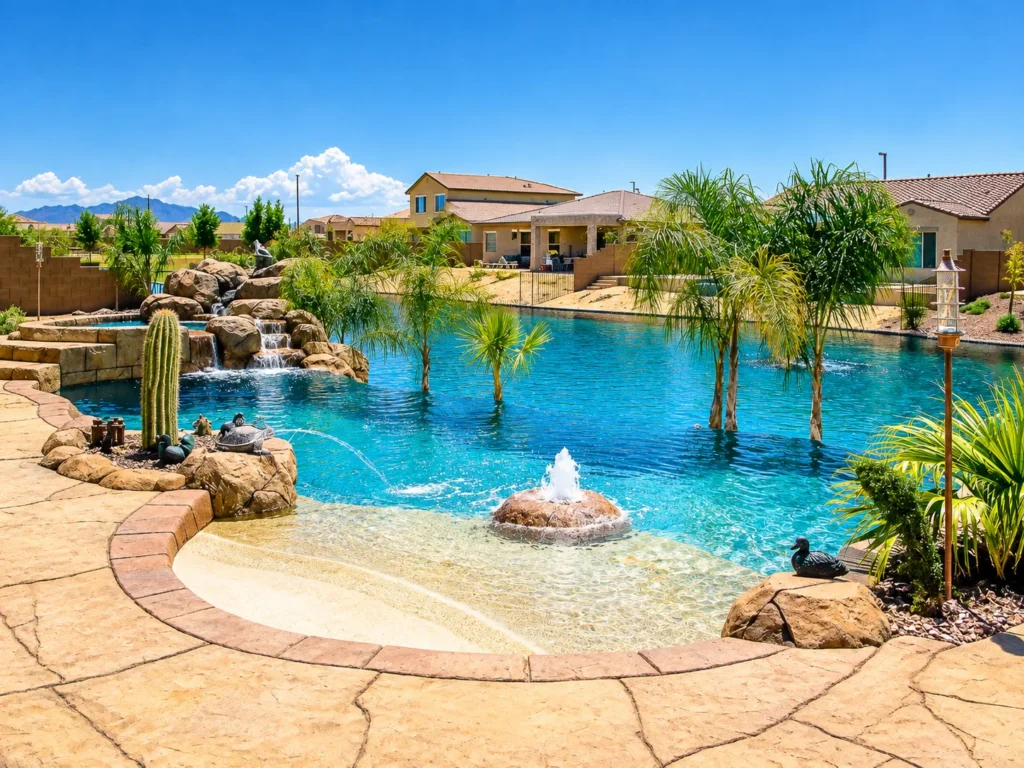
The slide is the strictest. S.R. Smith’s installation manual for its Garden Ride slide calls for at least 3 feet of water under the exit, deepening to 4 feet 6 inches a short distance out. A rockwork slide follows the same logic, so the landing goes in the main pool, clear of the beach and the current. We sort these zones out in 3D during pool design, because moving a slide landing after the steel is set is an expensive change.
| Feature | Depth it needs | Where it works best |
|---|---|---|
| Beach entry | Zero at the edge, sloping in gradually | Shallow end, near shade and seating |
| Lazy river channel | An even depth for floating | A loop around the main pool or an island |
| Rock slide | 3 ft at the exit, deeper just beyond it | The main pool’s deep section, clear of the current |
What Drives Backyard Lazy River Cost in Arizona?
Backyard lazy river cost comes down to the length of the channel and everything that runs along it. Every extra foot of loop adds excavation, steel, plaster, tile and coping, and the current needs its own pump, jets and plumbing. That’s why a lazy river is a high-budget specialty project rather than a standard custom pool with an add-on.
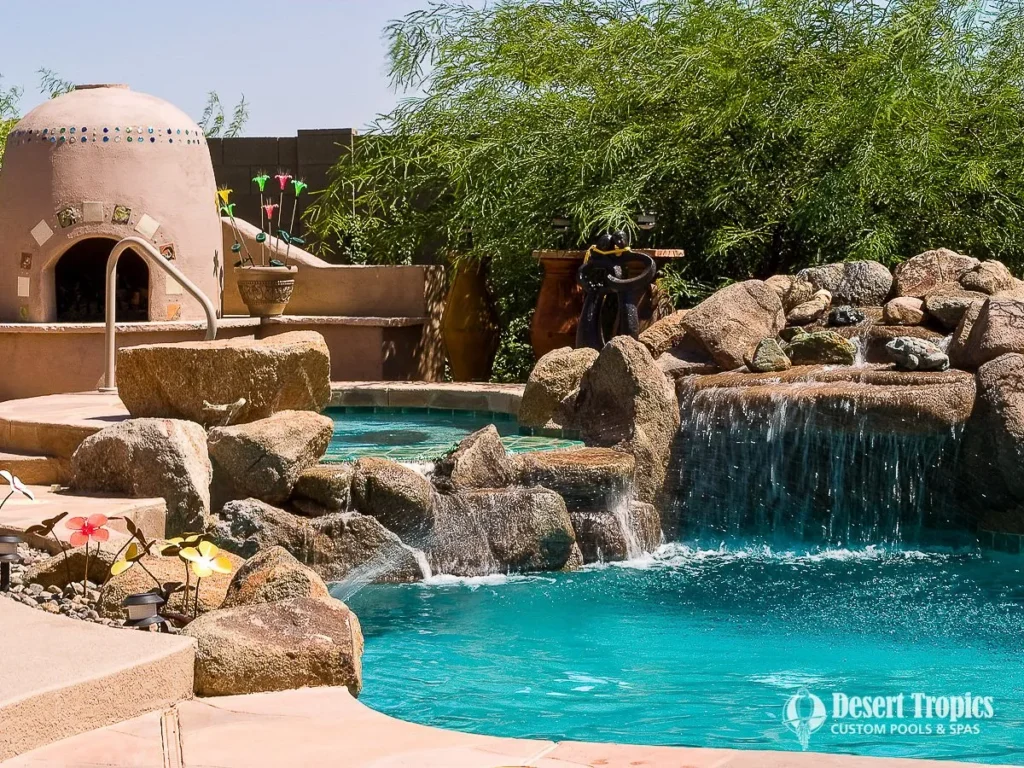
For context, most custom pools in the Phoenix area start around $60,000 and climb past $100,000 with premium features, which our guide to custom pool cost breaks down. A pool with lazy river, beach entry and rock slide stacks several premium features on that baseline. These line items move the number most:
- Channel length and width, which set the shell, plaster and tile quantities
- The current system, meaning a dedicated pump, jets and the plumbing that feeds them
- Rockwork and the slide, including the structure that supports the climb
- Decking on both sides of the channel, since a loop has an inner and an outer edge
- Site access for excavators and concrete trucks in established neighborhoods
Shortening the loop is the most direct way to lower the price without losing the float.
Safety Rules for a Backyard Lazy River Pool in Arizona
A backyard lazy river pool falls under Arizona’s barrier law at most homes where a child under six lives. A.R.S. § 36-1681 requires a wall or fence at least 5 feet high, a self-closing, self-latching gate that opens outward, and 20 inches of clearance from the water.
Those rules carry extra weight in a family layout. The CPSC’s 2026 drowning report found that drowning is the leading cause of death for children ages one to four. A beach entry makes the water easy to walk into, which is both the point and the risk. Moving water adds a second issue, because the current pulls water through suction outlets, and the federal drain cover standard requires pool drain covers to meet entrapment protection rules. We place barriers and gates in the design so they pass permit review, and our page for pool builders in Phoenix explains City of Phoenix permits.
Building and Owning a Residential Lazy River in the Desert
A residential lazy river takes longer to build and uses more water than a standard pool. Our custom pools typically run 4 to 5 months from contract to swim day, and a river adds forming, plumbing and rockwork on top of that. In the desert, the channel’s extra surface area also means more evaporation to replace.
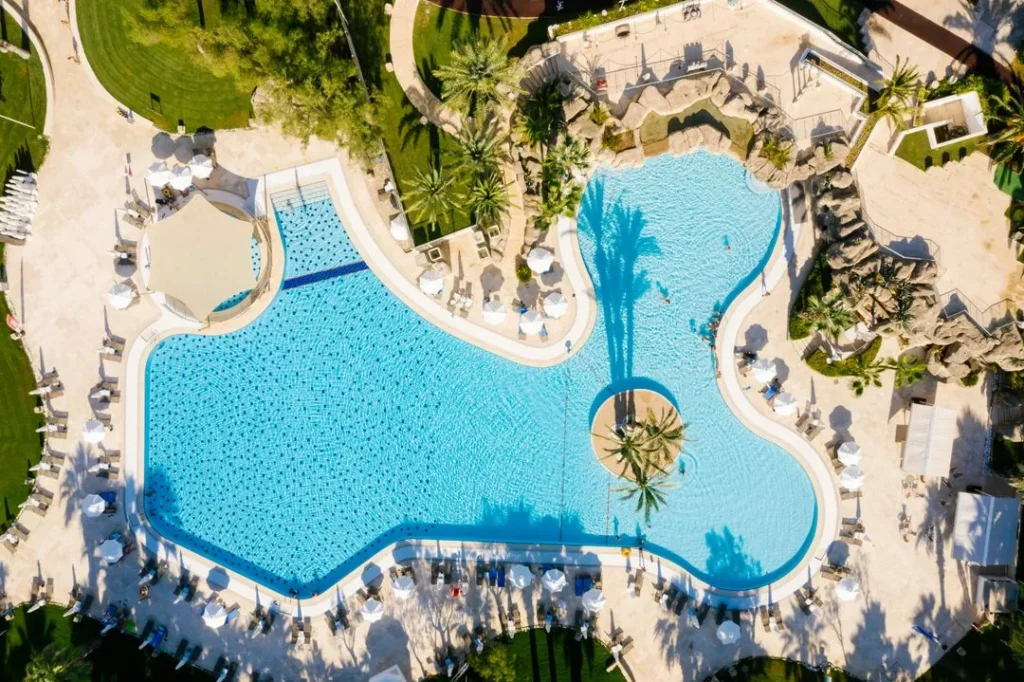
Our pool construction timeline walks through each stage, and the river touches nearly all of them. On the water side, Water Use It Wisely notes that a typical Arizona pool can evaporate its own volume in a year, about 20,000 gallons. A loop adds surface area and movement, so expect more summer top-offs and consider shading part of the channel. Our owner stays involved through the final walkthrough, so you won’t chase updates.
Backyard Lazy River Pool FAQs
How much does it cost to put a lazy river in my backyard?
There’s no flat price, because channel length, the current system, rockwork and decking set most of the number. Custom pools in the Phoenix area start around $60,000 and pass $100,000 with premium features, and a backyard lazy river sits in the high-budget tier above that. A design consultation gives you a number for your yard.
Can you have a lazy river in your backyard?
Yes, if the yard has room for a full loop plus decking on both sides, and the barrier can sit at least 20 inches from the water. A site visit and a 3D layout show quickly whether a river fits or whether a beach entry and slide make more sense.
How do you build a lazy river in your backyard?
A permanent lazy river is built like a custom concrete pool: excavation, steel, plumbing for the current jets, a sprayed shell, then tile, coping and plaster. The channel and the main pool are designed together and permitted as one project. It’s not a DIY build, because depths, suction fittings and barriers all have to meet code.
What is a beach entry pool?
A beach entry pool has one edge that slopes from deck level into the water gradually, the way a shoreline does, with no steps. It’s popular with families because small kids can sit in a few inches of water and older adults can walk in without a ladder. It takes more pool area than steps do.
Is a pool rock slide safe for kids?
A pool rock slide is safe for kids when it lands in water deep enough to meet the slide maker’s depth envelope, riders go feet first, and an adult watches the landing. The risk comes from shallow landings and from crowding the exit, so the slide should land in the main pool, away from the current.
Planning Your Backyard Lazy River Pool
The real decision with a backyard lazy river pool is whether your yard and budget can give the river, beach entry and slide each their own space. If they can, you get a pool the whole family uses together. If they can’t, a beach entry and a slide on their own deliver much of that fun for less.
Since 2001, we’ve designed custom pools across North and West Phoenix with the owner involved from the first sketch. Call (602) 787-1603 or request your free design consultation and we’ll walk your yard together.